Hawaiian Airlines puts carry-ons on a gate scale and enforces a straight 25-pound limit, no exceptions for a good excuse or frequent-flyer status. That single fact catches more business travelers off guard than almost anything else about domestic carry-on rules, because most other major airlines treat a bag's weight as background noise.
Dimensions get checked constantly. Weight, on most mainline routes, barely gets a glance, which is exactly the gap that causes trouble the first time a trip includes a regional jet or a budget carrier instead of a standard 737. This is the part of domestic luggage rules that rarely gets explained clearly, and it's worth walking through properly instead of learning it at a gate counter.
The Carry-On Weight Limit Nobody Mentions at Booking
Legacy carriers — Delta, American, United — build their carry-on policy almost entirely around size. They want to see a bag hit roughly 22 x 14 x 9 inches, enough to close the bin door without a fight, and once it clears that bar, nobody cares whether it's packed with a week of suits or a box of bricks. It's the same logic as picking a daily driver instead of a road-trip car: the only real requirement is that it fits in the garage.
Regional jets break that logic completely. A lot of domestic itineraries now run through a CRJ200 or similar aircraft for at least one leg, and those planes are far more sensitive to weight and balance than a mainline jet. A 40-pound carry-on is a non-event on a wide-body; on a 50-seat regional aircraft, it's something the flight crew is actually accounting for before pushback.
Which Airlines Actually Put a Bag on the Scale
Hawaiian is the clearest example: a hard 25-pound carry-on limit, weighed at the gate, no gray area. Spend enough time around a Hawaiian-bound connection and you'll eventually see someone pulled aside for running a few pounds over, with no polite way around it. Standing at the counter looking betrayed does not change the number on the scale (I've tried). The bag gets valet-tagged and goes into the hold instead of the bin.
Frontier sits at a looser but still real 35-pound limit, and the airline leans harder on dimensions than weight, but they keep a metal sizer right at the gate, and if a bag doesn't slide in clean, the conversation about the bin's structural limits starts fast. The practical rule: if any leg of a trip touches a carrier like Hawaiian or Frontier, pack to that number, not whatever the mainline leg would have allowed.
The one constant across all of it is the TSA 3-1-1 rule: stay under 3.4 ounces per liquid container, which matters more than it sounds like, because liquids are some of the densest things in a bag. Close to a 25-pound ceiling, a full dopp kit of hair gel and sunscreen stops being trivial. I've run real-world testing of the industry's hardest working bags on routes like these, and the results usually trace back to how much the bag itself weighs before anything goes inside it. My colleague Roz, who flies nearly as often as I do, gets around some of this by carrying a tote that technically breaks the personal-item rule; nobody at the gate weighs that bag, which says a lot about where airlines actually point their attention.
Why Regional Jets Treat Weight Differently Than Mainline
Overhead bins on regional aircraft carry actual weight ratings, not just size specs. Flight crews on Embraer and CRJ aircraft will tell you the bins weren't engineered for the density road warriors try to cram into them. A bin built for six modest bags straining under four oversized ones is a structural question, not just an inconvenience.
That's the real reason gate-check or "valet" service exists on smaller planes. The bag might fit the 22 x 14 x 9 standard on paper, but the bin still can't absorb the combined mass of twenty business travelers' worth of laptops and dress shoes, and that overrides whatever status is printed on a frequent-flyer card. Overpacked bags pay for this in ways beyond fees, too; I've seen premium bags, from brands that will stay nameless here, have their frame visibly warp after one too many trips stuffed to capacity for a week-long conference.
Heavier Isn't Always the Problem
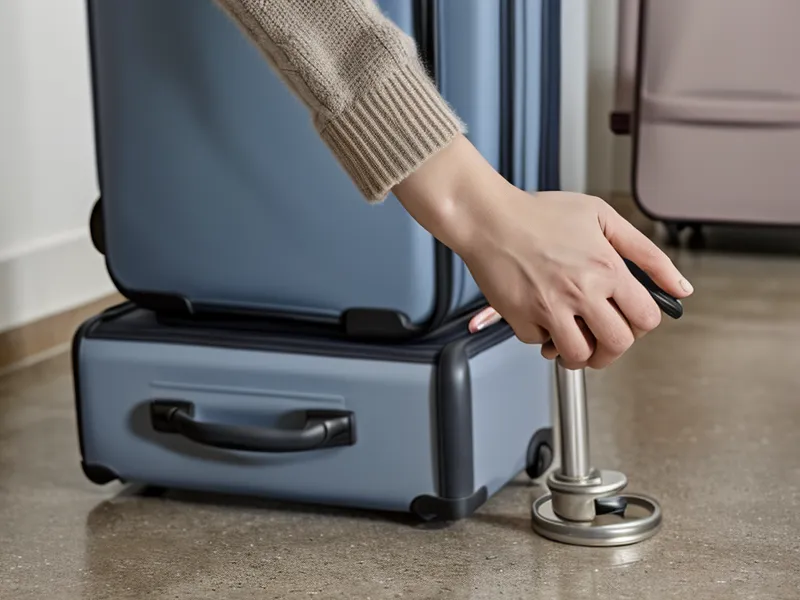
Chasing the lightest possible shell is a common mistake, and it runs against most of the advice floating around travel sites. A bag with next to no heft behaves like a flimsy knife: it skitters and tips the moment it hits a transition strip, because there isn't enough weight low in the frame to keep it tracking straight. A no-name spinner I grabbed off Amazon on impulse one year taught me that the hard way. The wheel casing cracked on its second trip, and I found out exactly how bad it was while speed-walking through O'Hare's H concourse toward a gate that was already boarding, the bag rolling fine for three strides and then very much not.
A little mass, something closer to seven or eight pounds empty, gives the wheels something to bite into and lowers the bag's center of gravity enough to matter. Anyone asking why your spinner wheels keep failing after a year of business travel is usually looking at one end of that spectrum: either a bag so light it's bouncing under lateral stress, or one so overloaded the bearings are taking a beating they weren't built for. The real sweet spot has less to do with grams saved than with where the weight actually sits in the frame.
Packing to the Strictest Leg, Not the Easiest One
The practical approach is to stop packing for the flight you're on and start packing for the worst leg of the itinerary. If a connection touches a regional jet or a 25-pound carrier, pack as if that number is the actual ceiling for the whole trip, not just one segment of it. That single habit does more for a bag's weight problem than any gear upgrade: aim for something in the 25 to 30 lbs range as a general target, regardless of which carrier shows up on the boarding pass.
Family trips complicate this fast, since the math has to work across multiple bags and multiple packers, which is part of why shipping family vacation bags ahead to save time at the airport ends up being worth the tradeoff on some trips rather than fighting gate agents and overhead bins at the same time. A reader named Marcy pushed back once on a "just buy the lightest bag you can find" recommendation, and she had a fair point. The lightest bag in the world doesn't help if it can't hold a straight line through a terminal or survive the edge of a gate sizer. Getting the weight right saves the back and the wallet in roughly equal measure, and it's the kind of airport logistics that's easy to ignore until a gate agent is holding a scale and your boarding group.