
What's a working shoulder actually worth to a regional account manager? I used to answer that with a shrug, because the cost of hauling sample cases through Terminal A at Indianapolis International felt baked into the job already — you fly business travel every other week, you carry what the territory demands, end of discussion. Then I started running an actual ledger against Luggage Forward, the shipping service I eventually leaned on for the heaviest trips, and the carry-on-versus-ship-it math turned out to be a lot less obvious than that shrug suggested.
Quick disclosure before the ledger: some of the links below, including the ones for Luggage Forward, are affiliate links. If you sign up through them I earn a commission at no extra cost to you. I only write about services I've actually shipped a sample case through, and current pricing always lives on the provider's own checkout page, since it moves with fuel surcharges.
The Hidden Shoulder Tax of Business Travel in a Regional Territory

Covering five Midwestern states out of a home base south of Indianapolis means hopping three short regional flights in four days more often than any travel blog would admit is normal. A territory manager doesn't pack a wash kit and call it done — we travel with collateral, binder packets, mechanical demo parts, sample cases with real weight to them, and anything bigger than a briefcase risks running into the standard carry-on ceiling of 22 by 14 by 9 inches. Go past that, and you're gambling on gate-check roulette at Terminal A, where regional jets out of secondary hubs tag anything bigger than a bread loaf before you've even found your row.
Checking a heavy case curbside has its own ceiling. The standard domestic airline overweight threshold sits at 50 pounds, and crossing it hands you a penalty fee that would make a corporate auditor wince. I've already mapped out how those fees stack up against shipping in comparing luggage shipping services vs airline checked bag fees, so I won't re-run that math here.
Before I ever looked at a shipping service, my answer to the weight problem was buying tougher luggage. A sale-rack Samsonite hardshell from the outlet felt like a smart stopgap for about eight months, until the corner seam gave out mid-trip and dumped a folder of product sheets across a jet bridge in front of a gate agent who didn't look especially surprised.
That split seam was the push I needed. I set up an account with Luggage Forward to see whether shipping the heaviest cases straight from my staging room — a spare bedroom with the floor cleared wide enough to roll a full case end to end, a pegboard of wheel axles and zipper pulls salvaged from bags that didn't make it, and a rack along the back wall holding whatever test case is waiting for its next trip — to client-facing hotels could fix the problem for good.
What Does a Static Anchor Trip Actually Look Like?

A static anchor meeting is the easy case: the date and the city have been locked on the calendar for a long stretch, nothing about the agenda is going to shift, and the only variable is how much gear needs to show up looking presentable.
My own test of that theory came on a multi-day account presentation near Minneapolis, hauling roughly fifty pounds of demo parts and presentation swatches that had no business riding in an overhead bin. The courier took the case off the porch of that staging room on a Monday morning, and by the time I landed Thursday afternoon, the physical contrast was hard to overstate.
Clearing the jet bridge with nothing heavier than a laptop sleeve has an odd lightness to it — no backward glance at an overhead bin, no weaving around slow walkers dragging a kickstand wheel. Everyone else stood four deep around the carousel, watching the rubber flaps and breathing in jet fuel drifting through the ground-crew doors, while the walk to the rental counter took about thirty seconds flat.
The hotel lobby did its own small flex — marble floor, cool underfoot, nothing in my hands but a shoulder bag — and the front desk clerk pointed behind the counter before I'd even asked, because my case had beaten me there by three hours. The real payoff didn't show up until that night. Unzipping the case well past midnight, worn out from a client dinner that ran long, I found the dress shirts sitting exactly as flat as they'd been at five that morning when I folded them, untouched by a trunk, a jet bridge, or anyone else's bag stacked on top.
Luggage Forward backs that kind of arrival with a guarantee that refunds you twice what you paid to ship it if the package misses its window, which did more to calm my sales VP's nerves about the materials ending up in some sorting facility than any tracking link could.
Running a Multi-City Domino Schedule Breaks the Math
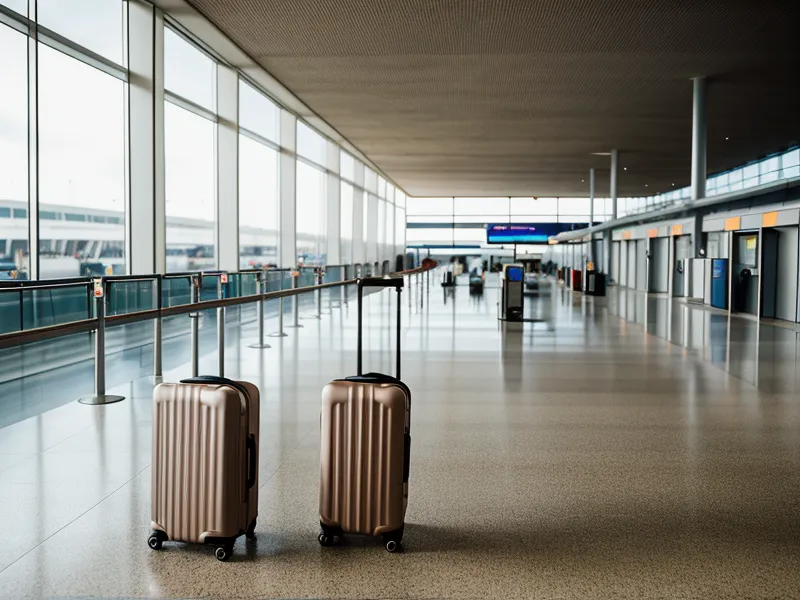
Single-destination trips make shipping ahead look like a solved problem: schedule the pickup, let the courier work, show up carrying nothing but a shoulder bag. Regional account work rarely offers that courtesy.
Our calendars run multi-stop domino chains instead — Indianapolis to Columbus, a drive to Cleveland, a commuter hop to Grand Rapids, a client dinner in Milwaukee, all inside one trip. Forwarding logistics assume a predictable pickup-to-delivery window, and a different hotel every single night turns that assumption into a coordination headache. You're not scheduling one shipment, you're running a relay where the Grand Rapids box has to beat you there while the Columbus box is already routed home.
That relay snapped the one time a Grand Rapids client moved a Friday meeting up a full day to work around their director's travel schedule. Ground shipping booked on a Wednesday morning for a Friday presentation missed the client's opening remarks by a wide margin, because a delivery truck already out on the interstate can't reroute itself just because your itinerary changed. The gear stayed locked to its route while I stood in a boardroom with an empty hand truck and an iPad full of slides.
On routes that reshuffle without warning, the bag that survives is the one strapped to your own arm. My old Briggs & Riley and the Travelpro I eventually wore through both earned their keep for exactly that reason — they move the instant you do, with no courier standing in between. Denny Abara, the neighbor two doors down who spent years as a logistics consultant before going fully remote, keeps a running spreadsheet comparing how strictly different carriers enforce that carry-on limit depending on the hub, and his numbers back up what the domino runs taught me the hard way: enforcement is far less consistent than the posted dimensions suggest. If you want the deeper breakdown of how different carry-on constructions handle that overhead-bin squeeze on unpredictable hops, I cover it in why softside luggage fits better in small regional jet overhead bins.
Shipping Ahead Pays Off Under Three Conditions, Not One
Three conditions decide it for me now, and all three have to point the same way before anything leaves the staging room. The first is a static anchor meeting — a big annual review, a client training seminar, a regional trade display where the date and city locked in long ago and nothing short of a blizzard will move it. The second is the fifty-pound wall: a presentation kit or mechanical sample box heavy enough that airline overweight penalties start rivaling ground shipping costs anyway, at which point checking it yourself stops being the cheaper move. The third is multi-person utility — duplicate sales kits or shared collateral landing at one hotel so three territory reps can all show up carrying nothing heavier than a shoulder bag.
Hit all three and Luggage Forward earns its keep without much debate. Miss even one of them — especially once your itinerary stretches past a single city — and you're better off keeping the load strapped to your own arm, because a bag that moves when you move will always beat one that's betting on a trucking schedule holding still.
Setting up an account with Luggage Forward is worth the research if you're hitting the same physical wall I hit, hauling trade gear through regional hubs until your shoulders feel permanently uneven. Run their transit estimates against your own calendar before you commit a static anchor trip to it, and don't mistake the service for a replacement for a carry-on that can survive the unpredictable weeks. Treat it as a specialized tool you reach for only when the schedule actually holds still.